The Unseen Instrument: Decoding the Four Parts of Your Inner World
Reshma Krishnan
1/19/20266 min read
What would you do if you were suddenly shoved into the driver’s seat of a speeding vehicle you had only ever ridden as a passenger?
For most of us, this is exactly what our inner world feels like: a Black Box. Impressions go in, reactions come out, but we only have a vague idea of what happens in between. We rarely question why we felt that flash of anger or how we decided to stay silent when we should have spoken. We voluntarily place ourselves in the passenger seat of a vehicle we were born to drive.
But what happens on the days you actually want to drive? You cannot command a vehicle you do not comprehend. If you want to take charge of your lived experience instead of cruising on Autopilot, you must first learn the controls that dictate the quality of your ride.
An Evening Ambush
It's 7:00 PM. You are finishing a few work emails, winding down, half-watching the news. Your teenage son walks in.
"Dad, did you get the bank account thing done?"
You feel the interruption land. A small spike of guilt hits you—you haven't done it yet. You meant to, the week was a blur of deadlines. Before you can apologize, he snaps.
"You said the same thing last week! You had no problem sorting out nugget’s trip the minute they asked. Why am I always the one who has to wait and ask repeatedly? You clearly have favorites!"
Boom.
The guilt evaporates, instantly replaced by a surge of defensive rage. Your heart rate spikes. Your jaw locks. You feel the Internal Lawyer in your head building a closing argument: a list of every sacrifice you have made, every tuition bill paid, and a blistering counter-accusation about his ingratitude already loaded and ready to fire.
You are seconds away from letting the retort fly. Winning the argument, but fraying the connection.
Then, your phone pings.
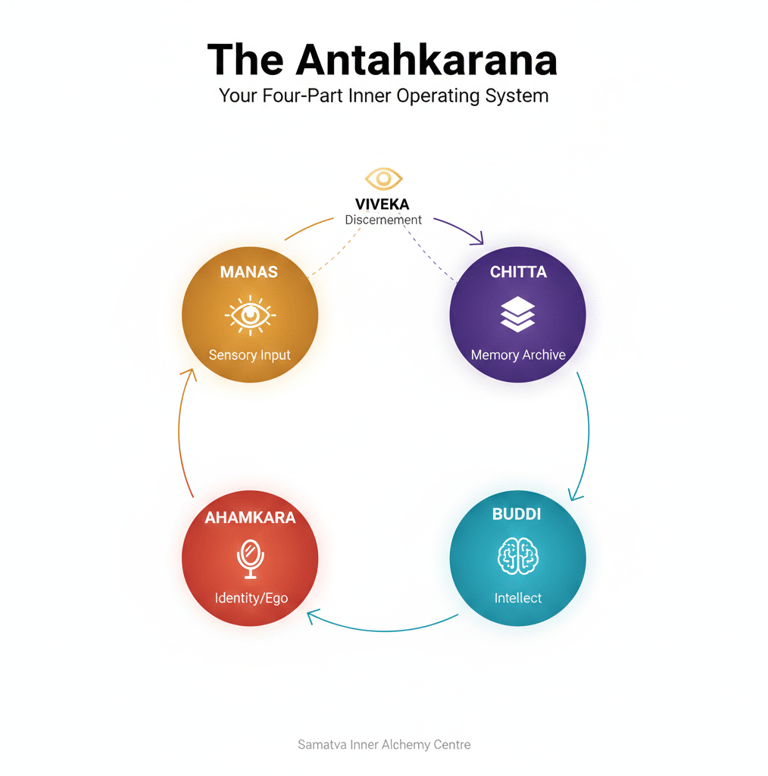
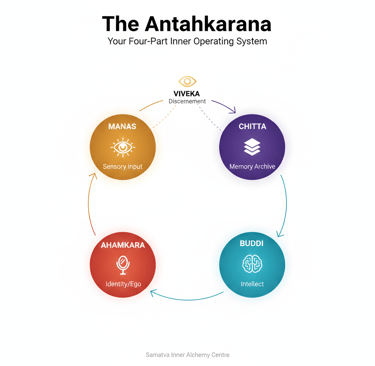
A notification lights up the screen. It's a comment on a post you read that morning about the Antahkarana, the four-part architecture of the human mind.
That microsecond of distraction acts as a glitch-in-the-matrix. In the space between his accusation and your explosion, the camera freezes on this specific scene of your life.
For the first time, you don't just FEEL the defensive anger rising; you SEE the inner machinery creating it in real time.
The Resolution
You don't yell. You don't defend your oversight. You put the phone down, look him in the eye, and say:
"I hear you. I said I'd handle it and I didn't. And I can see why that feels like you aren't a priority. Let's do it right now. It'll take ten minutes."
He stops. The wind goes out of his sails. The "enemy" he was prepared to fight has vanished, replaced by a calm, sorted (albeit forgetful) parent. He relaxes and gives a sheepish smile, realizing he was bracing for a fight that never came.
The evening is saved.
Why Awareness is Only an Emergency Brake
Most of us live our lives without ever realizing we have this internal dashboard, let alone sparing a glance at it. When the default inner sequence triggers an emotional surge, we let those emotions drive the vehicle.
This is the Autopilot.
For much of our lives, the Autopilot is a lifesaver. You don't want to use active agency to clean the house or perform routine tasks. These are Samskaras (Defaults) that keep your daily life efficient.
But while Autopilot is essential and efficient on smooth roads, it is unpredictable and dangerous during turbulence. In high-stakes moments (a child's outburst, a partner's silence, a boss's critique) your responses derived from default settings can lead to a crash.
The 85/15 Reality
Your lived experience (The habits, quirks, conscious decisions, deliberate actions, visible results, arguments, wins, and losses) is just the 15%.
But those outcomes are dictated entirely by the 85%: the invisible architecture of your Antahkarana.
If you want different results in the conscious 15% of your life, you cannot just try harder.
Willpower alone is a weak tool against a lifetime of defaults.
You must learn to read the instruments in the unconscious 85% so you can eventually rewrite the defaults that no longer serve you.
Awareness of the Antahkarana is the difference between being a passenger in a crashing car and being the driver who knows exactly which pedal to press to regain control.
You don't need to be a monk to salvage a week night going sideways; you just need to know how your inner equipment works.
Take the Wheel
The next time the heat rises, don't immediately react. Spare a microsecond to check your internal dashboard.
Is the Manas over-reporting the threat?
Is the Chittha pulling up stale, irrelevant files?
Is the Ahamkara making it about you when it isn't?
The moment you become aware of your Antahkarana, you sense a shift. You have made the decision to stop being a passenger and start being the driver of your life. Or at least a passenger who knows exactly who is driving and where the vehicle is headed.
The Limitation (And the Solution)
In this scenario, you got lucky. The phone pinged at the exact moment you needed an interrupt. But the phone won't always ping.
When you are tired, hungry, or stressed, the default sequence will run before you even notice.
Awareness is the first step, but it rarely holds up under extreme pressure. You need more than recognition; you need Emergency Protocols and the skill to calibrate your Inner Architecture by design.
I have curated a vault of 18 field-tested verbal scripts designed to act as a circuit breaker for your nervous system. These are precise verbal interrupts that bring your Viveka-guided Buddhi back online when your system is screaming Red Alert.
They buy you the 90 seconds of clarity you need to hear the quiet voice of Viveka before you say something you'll regret.
Download the Samatva Verbal Shield Scripts
What about you? How do you handle these 7:00 PM moments?
Have you ever caught your Internal Lawyer building a case against someone you love? Or have you ever caught yourself mid-hijack and changed course?
Share your thoughts in the comments below or connect with me on socials. I would love to hear how you navigate your internal dashboard.
The Diagnostic: Decoding the Mechanism
In this frozen moment, you are witnessing the four parts of your internal instrument (The Antahkarana) running its default sequence.
These components are doing exactly what they were designed to do (protecting your identity), but the result is a domestic disaster in the making.
The sequence unfolds in the Antahkarana with clinical speed:
1. Manas (The Sensory Processor)
It registers the raw input: High volume detected. Accusatory tone. Comparison to sibling identified.
The Reaction: It treats his frustration like a physical threat, sending a Red Alert to your nervous system. This is why your chest feels tight and the heat rises.
2. Chittha (The Archive)
It pulls the Unfair Treatment file from your memory bank.
The Reaction: It reminds you of every other time you felt unappreciated. It provides the evidence that you are being attacked, triggering a defensive history that has nothing to do with a bank account. It stacks the case against your son using decade-old data.
3. Ahamkara (The Ego/Identity)
It props up the I-am-a-Good-but-eternally-Misunderstood-Parent persona to defend your worth.
The Reaction: It takes a logistical oversight (the forgotten task) and turns it into a personal insult. It makes the conflict about your value as a parent, not his need for independence. It conveniently ignores the fact that you did, indeed, forget the task.
4. Buddhi (The Intellect)
It receives the distorted data from the first three components.
The Reaction: It receives junk-data under high pressure and becomes a co-opted lawyer. Because the situation feels urgent, it trusts the Ego's narrative and Viveka (Discernment) remains offline. Thinking that a victory is required to protect your image, the Buddhi drafts the perfect retort to crush your son's logic.
The Shift: Bringing Viveka Online
The Antahkarana is a lightning-fast miracle. It performs this entire diagnostic instantly. Usually, we are just passengers while this internal conversation dictates our responses. We obey automatically because we are operating on Factory Default settings.
But in this instance, you paused. Because of a phone ping. That interruption broke the default sequence and allowed Viveka to intervene.
Viveka is the Senior Partner to the Buddhi. While the Buddhi processes logic, Viveka provides the clarity to see if that logic is actually useful. It asks the one question the Ego doesn’t: "Is he actually attacking me, or is he just hurting? Is there more to the narrative than the one being played out by default?"
This shift moves the inner team to recalibrate. Chittha and Buddhi re-examine the data given by Manas and the nuances missed in the heat of the moment are registered:
Your son is at the cusp of adolescence, desperate for independence. To him, the bank account isn't an errand; it's his ticket to adulthood. His comparison to his sibling isn't a factual report. It's the only leverage a stressed child has to express disappointment.
The internal response sequence changes. The heat in your neck is still there (the physiological echo takes a moment to cool down), but the psychological hook is gone.